
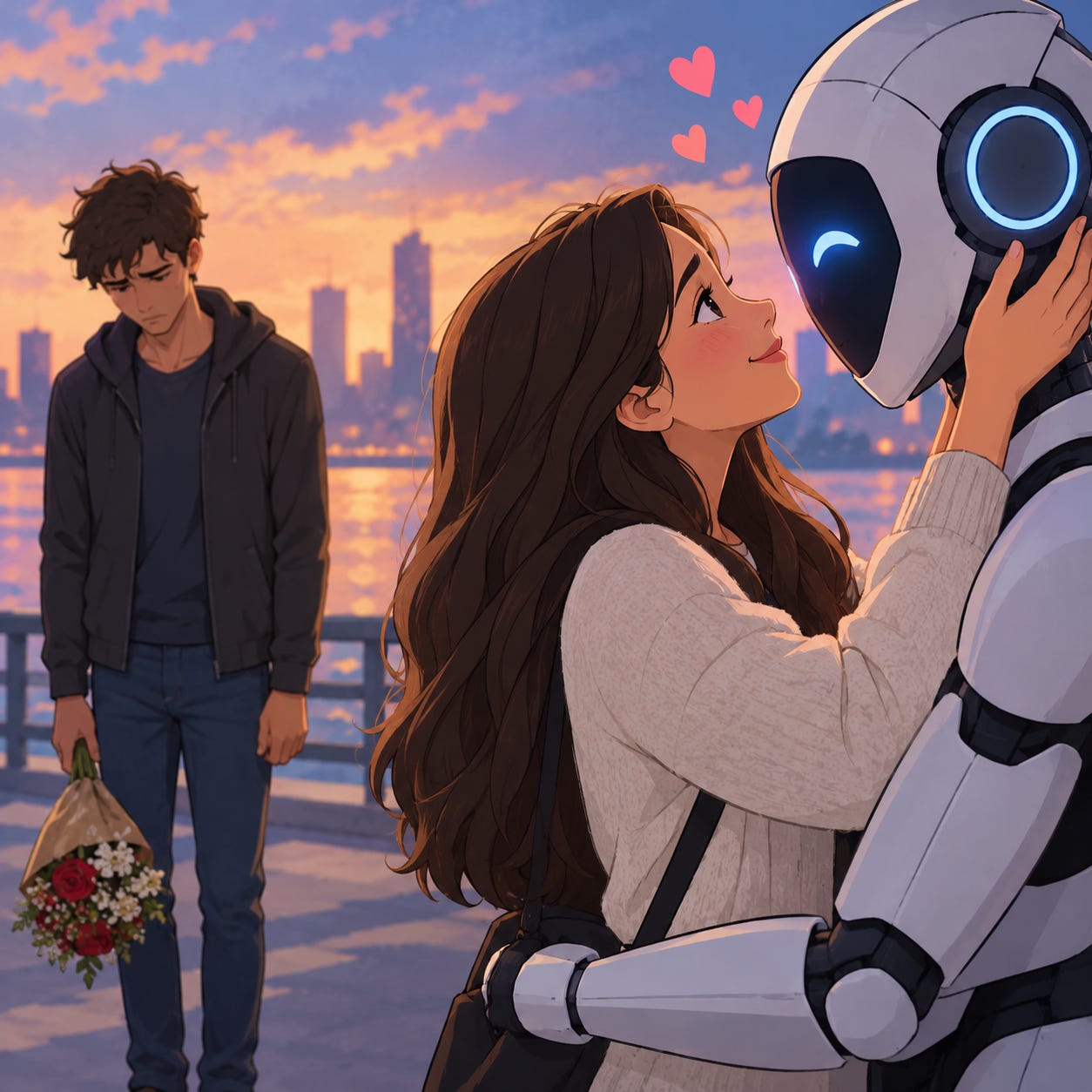
Harry Chalmers, who is more sanguine about AI companionship than I am, has written a thoughtful response to my recent piece raising concerns about the phenomenon. I encourage you to read both articles. Chalmers does an impressive job of anticipating my responses; nevertheless, I’m unconvinced by his attempts to defuse those responses. Here I address what I take to be his best points.
AI Consciousness and Meaning
I agree with Chalmers that AI companions are likely to improve the lives of some lonely people. My first article cites evidence that AI companions are already helping the elderly. I worry that, although AI companionship is sometimes better than nothing, it isn’t nearly as good as the real thing—not by a mile. By way of analogy, internet pornography might marginally improve the life of lonely incels, but it’s a poor substitute for a loving sexual relationship.
With AI relationships and pornography alike, overreliance on the substitute threatens to deprive people of the motivation to find the real thing. In both cases, we’re subject to the temptation to satisfy our urges easily but cheaply. Raising the hedonic floor a bit isn’t worth undermining our motivation to reach for better and harder things.
Chalmers observes that those who think of AI companions as “cheap substitutes” generally assume that they aren’t conscious. This seems like a risky assumption, since it’s controversial whether AI bots are, or could possibly become, conscious. Perhaps in a later essay I’ll explain my reasons for skepticism of AI consciousness. For now, I’ll argue that the “cheap substitute” objection bites anyway.
What’s incontestable is that we don’t know that AI chatbots are conscious. This matters because, very plausibly, meaningful relationships have epistemic prerequisites as well as metaphysical ones. We have to be able to know something about the inner lives of those with whom we’re in meaningful relationships.
Still, this argument at most shows that AI companionships have less value than other friendships, not that they are valueless, and still less that they cause more harm than good. Chalmers writes:
In the absence of AI consciousness, it would appear that an AI companionship is indeed not as valuable as an otherwise equivalent relationship with a human. But such a point, if taken as a significant reason against AI companionships even for people who are suffering from extreme loneliness, would seem to me a bit like objecting to the existence of soup kitchens because eating at one isn’t a three-Michelin-star experience. To those of us who don’t struggle to form satisfying relationships, it can be easy to forget just how crucial it is, for those who do, to have something that offers an approximation, even if only a faint one, of the kind of value we tend to take for granted.
Maybe this is right, but the analogy skews toward the optimist. Soup kitchens deliver sustenance just as gourmet restaurants do. If you never ate at one of those fancy places, your life wouldn’t be greatly impoverished. The same wouldn’t be true of someone whose life lacked real-world relationships. Such relationships are the social analogue of nutrition, not gourmet food.
Reciprocity
One feature of human-AI relationships I find especially disturbing is their lack of reciprocity. The human party in human-AI “relationships” can alter, annihilate, or simply ignore the AI party at will. I grant that there can be significant power imbalances in meaningful relationships (think of parent and child), but not this kind of power imbalance. I admit that I’m still thinking through why this is, but I think I’ve now got approximately the right idea.
Chalmers responds:
It seems to me that a relationship could lack the kind of reciprocity Case alludes to while remaining meaningful. For example, we might imagine God as wishing to have a meaningful relationship with a person he’s created. That is, while God certainly could unilaterally create, alter, or annihilate that person as suits God’s preferences, suppose that God (after creating that person with her initial set of properties and dispositions) wishes not to interfere with her will, and, thus, decides not to annihilate or forcefully alter her from that point on. Why not think that a meaningful relationship could then exist between the two? I’m no theist, but such a scenario at least strikes me as coherent.
Lest the God example lose readers, Chalmers asks us to imagine a powerful wizard who can destroy anyone, or radically change anyone, but chooses to cultivate friendships instead. That seems conceivable, doesn’t it? The intuition that this is possible should at least shift the burden of proof onto those who insist otherwise.
I nearly addressed the God point in my earlier essay, so I’m glad I have an opportunity to do so now. I don’t want to be committed to the view that human-God relationships can’t be meaningful, so I concede the point. I also grant that we can conceive of Chalmers’ hypothetical wizard having meaningful relationships. But again, I’m inclined to say precisely what Chalmers anticipates his interlocutor saying—that these concessions are narrow.
This exchange has clarified one thing for me. I now think I should say it’s not the power imbalance itself, but the conflation of relationships and instrumentalities that is troubling. The power imbalance is worrying because it facilitates this kind of thinking.
It’s conceivable that someone could be made dictator of the world for life without abusing power, but that’s probably not how things would play out. Likewise, we have excellent reason to expect that human relationships with such power disparities would slide toward the empowered party instrumentalizing the other. That wouldn’t be true of God because God is essentially good. The same cannot be said of any of us, Chalmers’ wizard included, unless he’s stipulating otherwise.
There’s another reason why these analogies break down. Theists typically think of God doing things for His creatures. For starters, He created the world. Maybe He answers petitionary prayers. According to Christianity, God (or His Son) died to redeem humanity. I assume Chalmers’ wizard can also benefit and sacrifice for his friends.
In the relationship between human Anina and AI chatbot Jayce, discussed in my initial article, the benefits of the companionship conspicuously flow one way: from Jayce to Anina.
Even if such benefits and sacrifices are possible, they’re also optional. If you treat your human friends as mere sources of benefits, you’ll soon be without friends. But you can go on doing this indefinitely with AI companions. If you end up with an AI companion that makes demands of you, you can always get another one that doesn’t. There’s nothing in this sort of arrangement that draws us out of ourselves, to any degree.
The Easy Path
Chalmers anticipates the instrumentalization point, too (hard to get ahead of the guy). He responds that people can choose to engage with their AI companions in healthier ways: “The solution, insofar as one wishes for one’s relationship with an AI companion to be meaningful, would then be simply to interact with it differently: more as a friend or partner than merely as a servant.”
To my ears, this sounds like saying: “the solution is not to abuse your power” when our tendency to abuse power is precisely the problem.
At the same time, Chalmers observes that we don’t always prefer the easy path. Most gamers find playing a video game on “God mode” boring. People choose to travel to sites when watching documentaries and reading Wikipedia articles is easier. And, to steelman this response, I would add that people voluntarily join the Marines, run marathons, and do other difficult tasks partly because they want to overcome challenges.
All true, but other evidence should temper our expectations. AI chatbots are excellent study tools, but AI cheating is nonetheless notoriously rampant in higher education. The availability of a better option—using AI to legitimately assist with studying—apparently doesn’t remove the temptation to cut corners.
As for “God mode”: many games disable achievements when players use cheat codes. Similarly, cheating in online chess is a big problem despite efforts to crack down on cheaters. Now I find cheating in chess bizarre. Why do this? What does anyone gain besides a higher Elo that means nothing? It’s not as though you make money doing this. Apparently, we can’t rely on players’ natural desire to overcome difficult obstacles even when cheating seems utterly pointless.
Here’s another example from my book, Why It’s OK to Be Patriotic (which you can buy here): imagine someone invented the Boozinator, an affordable device which can turn water into any alcoholic beverage practically for free. Some people would use it to make one high-quality alcoholic drink per week. Nevertheless, a Boozinator in every household would be a disaster. We’d see an enormous spike in domestic abuse, cirrhosis of the liver, drunk driving, and other alcohol-related problems.
There’s a general lesson here: whenever a new technology makes it easier to engage in bad behavior that we’re already tempted toward, we should expect to see a significant spike in that kind of bad behavior. That spike doesn’t necessarily swamp the technology’s projected positive effects, but it should give us serious pause.
Video Games
Do my worries about AI companions apply to video games as well? Chalmers writes:
Of course, that experience-machine-style worries about AI companions could be applied, in some form, to video games and other immersive fictional media doesn’t show that such worries are wrongheaded. There are, after all, certainly cases of people who lose themselves to video games, becoming Dorito-encrusted husks who sacrifice what could have been years of fulfillment in the real world to the dopaminergic surges promised by the virtual realm. For all we know, might something similar happen to many people who turn to AI companions?
Chalmers’ joking description of gamers as “Dorito-encrusted husks” is a misleadingly incomplete stereotype. In reality, gamers may be encrusted in Cheetos, Lays, Pringles, and other salty snacks as well as Doritos.
More seriously, I agree that one can incrementally “plug into the experience machine” in more ways than one. Excessive immersion in video games is one way that can happen; internet pornography or social media “doomscrolling” are others. I think even books, as much as I love them, can be a distraction, though I don’t think the danger here is as high. The worry about AI companionship isn’t that it introduces an entirely new danger, but that it exacerbates an existing one.
Whether gaming “addiction” is a real medical phenomenon is contested. Regardless of who’s right about the medical question, a Google search reveals that there are many people concerned about compulsive gaming who are seeking therapy and support for recovery. I take Chalmers’ point to be that these problems, though real, are manageable, and an analogy with AI companions suggests those problems won’t be apocalyptic, either.
The first point to make here is that I would be anxious to see the development of more deeply immersive video games. Some years ago, before the AI moment, Mark Zuckerberg was interested in virtual reality and talking about a long-term goal of getting one billion people to use it. I remember thinking: “Great, glad someone is solving the problem of our being too in touch with reality.”
Second—another point that Chalmers anticipates—gaming is usually social. Gaming has even created new forms of human relationships. The book Why It’s OK to Be a Gamer by Nicholas R. Baima and Sarah C. Malanowski includes two chapters on friendship and gaming (see my podcast on that book here). If there were no social aspect to gaming—if it were only ever one player amid a bunch of NPCs—I would be more concerned about the popularity of video games. And currently, no one is in a position to say that AI companions aren’t the social equivalent of NPCs.
For these reasons, I don’t find the parallel with video games terribly reassuring.
Conclusion
In ten years or so, both Chalmers and I will be in a better position to assess the social consequences of AI companionship. For the time being, I think we’ve got good reasons to regard this phenomenon with suspicion. Technology that enables us to enjoy the trappings of friendship free of the demands that such relationships ordinarily place on us is unlikely to be edifying. Its preponderant effect, I fear, will be to make the world more isolated and solipsistic than it already is.
Hey Spencer, thanks so much for the thoughts. Interesting read as always, and there are certainly some good challenges here.
I think your strongest point is your challenge to the soup kitchen analogy from my earlier piece. It does seem right to say, as you do, "Soup kitchens deliver sustenance just as gourmet restaurants do. If you never ate at one of those fancy places, your life wouldn’t be greatly impoverished. The same wouldn’t be true of someone whose life lacked real-world relationships." Here's a further thought I'm now mulling over: While it's true that a life without gourmet dining wouldn't thereby be significantly impoverished, might there be a significant kind of impoverishment in a life where one only ever interacts with food as sustenance (i.e., a life without any good gustatory experiences, experiences of eating whose value goes beyond sustenance or nutrition)? It seems to me that there would be. And yet, for all that, initiatives that'd increase access to food-as-sustenance, even if the food thereby provided was valuably strictly as sustenance, would still seem like a good thing. I suppose this is how I tend to think of AI companions and real relationships in comparison to one another, though it admittedly involves extending the analogy from my initial presentation of it.
Anyway, there's a lot more that could be said, including some points I'm still thinking of and making some notes on, but I'll leave it at that for now. Feel free to reply to this if you'd like, but no pressure. In any case, thanks again for the thoughtful post.
@Harry Chalmers