
1. Introduction
Suppose you learn that your least favorite politician has just died of natural causes. Imagine your reaction, and the reactions of your opponents. Now turn the tables and imagine a politician you support dying in the same circumstances. What would your reaction be to seeing displays of public jubilation from your fellow citizens who voted against this person? Ok, set those intuitions on the back burner and stir them every five minutes.
The idea that it’s wrong to insult the recently deceased—henceforth, “The Norm”—traces back to Roman times with the slogan: De mortuis nil nisi bonum dicendum est (of the dead, speak only good). The Norm continues to be sporadically invoked in discussions about the deaths of public figures such as Charlie Kirk, Lindsey Graham, and Jason Arday. Dolly Parton’s passing provoked no such discussion because no one had a bad word to say about her. If everyone were as universally beloved, we wouldn’t need The Norm. Alas, most of us are likely to be survived by people who judge our legacies to be more mixed.
Although the internet has produced spectacular examples of violations—as it does for every kind of rhetorical sin—The Norm still enjoys substantial support. Donald Trump’s unsympathetic reaction to the murder of filmmaker Rob Reiner and his wife, Michele, apparently at the hands of their troubled son, drew bipartisan condemnation. I think that’s an indication that The Norm is important enough to deserve elaboration. In what follows, I’ll describe The Norm in greater detail and offer what I take to be the best defense of it.
2. What is The Norm?
Observing The Norm means pausing expressions of contempt for someone for a period after that person has died. It’s not clear precisely how long this zone of silence is supposed to last, but it seems to be about as long as the period when people’s reactions to the news of the person’s death are the most intense. It’s ok to say bad things about the late Emperor Nero, such as that he was a tyrant, he murdered his mother, and he was a pretty mid lyre player—if I’m being generous.
The Norm applies mainly, or with special stringency, to public comments, not private remarks shared with a therapist or fellow mourner. And it primarily concerns harsh criticisms. Mentioning a person’s mild foibles can even be an endearing and humanizing detail to include in someone’s eulogy, so long as it’s more than balanced by the positive (note the etymology: eu + logia = good words).
The Norm applies to expressions of contempt that are true or at least well-grounded. Or at least those are the only interesting applications, since it’s uncontroversially wrong to spread baseless unflattering stories about anyone, living or dead. Perhaps there’s something especially bad about slandering the dead because dead people cannot defend themselves. This might give rise to a corollary precautionary principle: if you are going to harshly criticize the recently deceased, you should be especially diligent to make sure that what you say is true!
There’s a widely recognized carveout for the worst of the worst. Many Americans (including me) openly celebrated the death of Osama Bin Laden. When Joseph Stalin died in 1953, a restaurant in Washington, DC served free borscht to celebrate his demise. (The digital image of the woman putting up the sign celebrating Stalin’s death is copyrighted, but you can see it at the Getty Images webpage.)
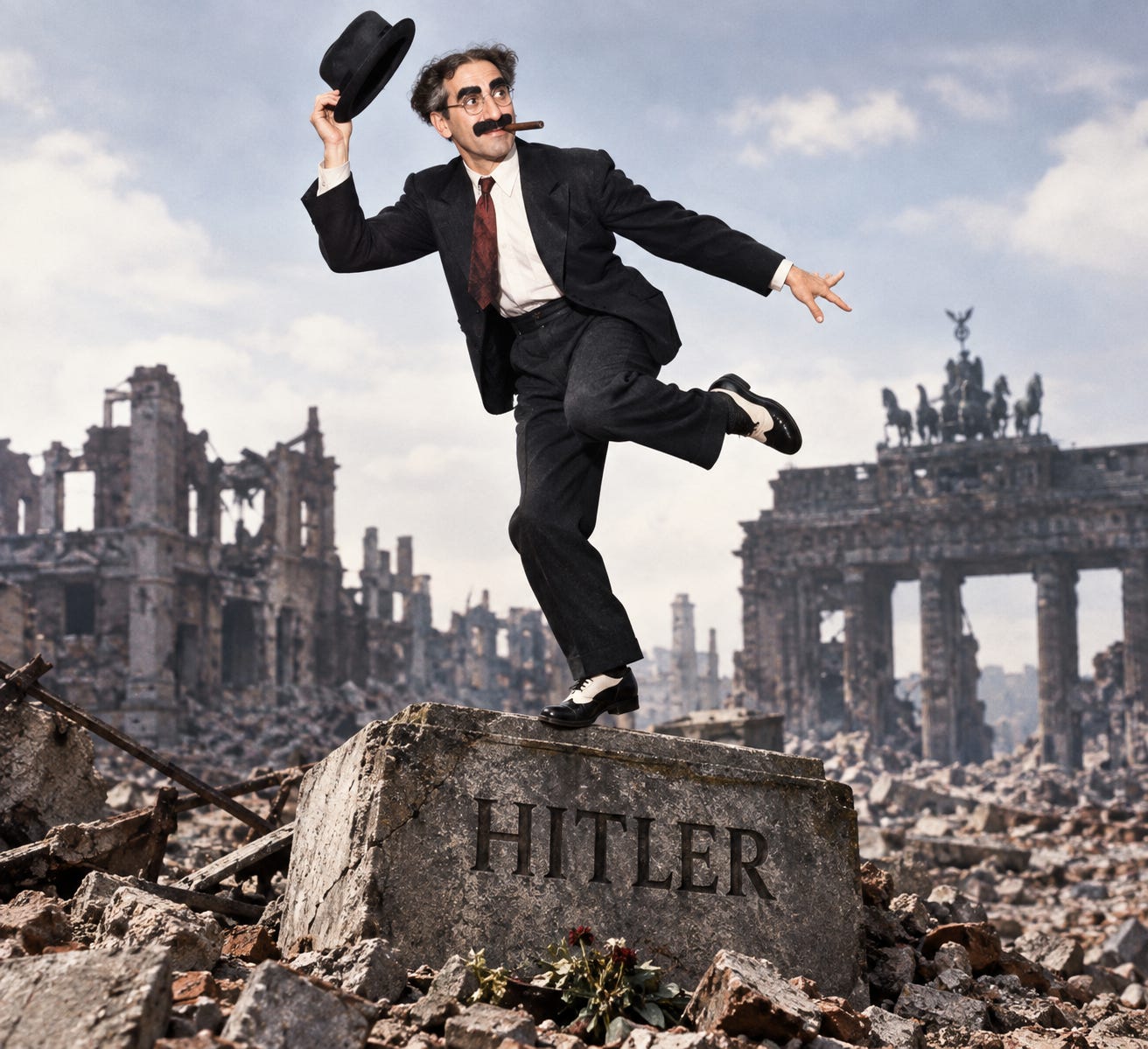
One of the most colorful death celebrations occurred in 1958. While touring Europe, comedian Groucho Marx danced the Charleston in symbolic defiance over a pile of rubble marking the bunker where Adolf Hitler ended his own life. This wasn’t in the immediate aftermath of Hitler’s death, but few would have faulted Groucho for performing the same dance in ‘45.
(That bunker was also where Blondi, Hitler’s dog—a German shepherd, naturally—was dispatched to doggie heaven when the Führer, then exploring suicide options, ordered the SS to give her a cyanide pill. That’s a handy factoid for vegetarians to keep in their back pockets for the next time someone brings up what a great animal lover Hitler supposedly was. Rest in Peace, Blondi; your owner didn’t deserve you, and Groucho meant no disrespect.)1
3. Brutal Obits
Just how bad do you have to be to cross the “good riddance” threshold? Do you have to be a terrorist or dictator, or is it enough to be a terrible parent? Although respectful obituaries remain standard, recently a few people have written obituaries to express their disappointment. In 2018, the Redwood Falls Gazette of Redwood Falls, Minnesota printed an obituary for Kathleen Dehmlow. It begins normally and then takes a scathing turn in the third paragraph (punctuation as in the original):
In 1962 she became pregnant by her husband’s brother Lyle Dehmlow and moved to California.
She abandoned her two children, Gina and Jay who were then raised by her parents in Clements, Mr. and Mrs. Joseph Schunk.
She passed away May 31, 2018 in Springfield and will now face judgment. She will not be missed by Gina and Jay, and they understand that the world is a better place without her.
Perhaps the most ruthless obituary in this genre, which can still be found on the funeral home’s webpage, begins: “Leslie Ray “Popeye” Charping was born in Galveston on November 20, 1942 and passed away January 30, 2017, which was 29 years longer than expected and much longer than he deserved.” And it gets worse from there, creating a picture of a person who must have been the moral inferior of Billy Bob Thornton’s character in Bad Santa.
In a statement to the media, the daughter who wrote the scathing obituary said: “I loved my father because he was my father and his passing would not have been any less difficult had he been a good father. As someone that ‘hated a liar’, I believe even he would have appreciated the honesty.”
It’s interesting that this one backhanded compliment—he appreciated honesty—didn’t make it into the obit. The daughter, speaking to those who were outraged by what she’d written, also revealed a mean streak of her own: “For those being cruel, please remember that you now resemble my father and I would be more than happy to pen your obituary as well.” Perhaps the apple didn’t fall so far from the tree. In any event, it highlights an important point about speaking ill of the dead: even when it’s permissible, it might betray a bad character.
For more examples of harsh obituaries, see here.
Cases of abusive relatives lead online grief coach Shelby Forsythia to dismiss The Norm as “B.S.” that harms the living: “If you’re someone who was harmed by a person who died, this societal rule reinforces a damaging idea: Your pain is less important than preserving the image of someone who’s no longer here.” Forsythia adds: “Let’s be clear: speaking ill of the dead isn’t about vengeance. It’s about reclaiming narrative power when your lived experience was denied or diminished in life” (bold in original).
Well, it might be partly about narrative control, but there’s an unmistakable element of revenge in the way Charping’s daughter points the spotlight at her father’s shortcomings, seemingly with relish, for four merciless paragraphs. Maybe it’s justified revenge, though I’m not convinced that post-mortem savaging is a promising way for survivors to find solace.
My main objection to Forsythia’s essay is that she dismisses The Norm altogether when the cases she discusses at most argue for qualifying it, extending the “worst of the worst” carveout to include people like Dehmlow and Charping.
4. Mixed lives
For all we’re told from the obituaries above, Dehmlow and Charping did little good to offset their badness. Other kinds of cases of bad lives raise different questions. Does the “good riddance” threshold track total bad, or net bad? If someone’s life is a net negative, but they also did some significant good, does this move the threshold? And does it matter whether that good is specifically moral good or do artistic and athletic accomplishments weigh in the balance?
Consider two mixed lives. Madison Grant was both a proponent of eugenics and a consequential figure in conservationism. Hitler referred to his book, The Passing of the Great Race, as his “Bible” in a fan letter to Grant. That, uh, goes in the negative column. On the other hand, Grant was instrumental in saving the American buffalo from extinction and protecting the redwood forests. John Newton, who wrote the hymn “Amazing Grace,” was involved in the slave trade before he became an abolitionist. Whereas Newton’s life had an incomplete redemption arc, for Grant, the good continued to coexist alongside the bad until the end. I think more charity is owed to Newton for this reason.
When it comes to mixed lives, it seems to matter who expresses contempt. Dehmlow’s obituary, written by her children, focused on a specific wrong—her abandonment of them. Not every associate of Dehmlow’s thought that this characterization was fair. A relative told NPR that he thought the obituary, though factually correct, painted an incomplete picture of a flawed person who regretted her mistakes. But it’s not clear that Gina and Jay are under any obligation to take that into account. Maybe her sin toward them was grave enough that The Norm doesn’t apply to Gina and Jay.
So the picture we have isn’t a simple one whereby everything depends on whether the person’s badness, however defined, passes some threshold. The Norm is much more sensitive to context. The nature of the sin, who is expressing the sin, and other facts about the life of the departed all bear on how The Norm should be applied in a particular case.
5. Reasons for The Norm
Now let’s turn to the next question: why should we be subject to The Norm? I’ll give three preliminary considerations before sketching the account I think seems most promising (though I postpone developing it for another day).
a. Harm to the dead
Perhaps we shouldn’t speak ill of the dead because doing so harms the dead. Some intuitions support posthumous harm. We do care about what happens to our legacies and reputations after we die. If the only existing manuscript of my novel, which would be headed toward publication and rave reviews, were destroyed immediately after my death, at which point I expected it to be published, then it’s not crazy to think that I’m in some sense harmed by this, and that others ought morally to take this into account.
Still, posthumous harm is philosophically controversial. It’s hard to see how a dead person can be harmed if death is annihilation (there’s no one around to be harmed!) This proposal also doesn’t explain why it would be especially bad to speak ill of someone in the immediate aftermath of his death as opposed to 30 years later, when The Norm no longer seems in effect. It also doesn’t explain why it wouldn’t be wrong—indeed, more wrong—to express the same contempt when the person was alive. After all, posthumous harm, if there is such a thing, usually isn’t as severe as the harm that hinders the interests of the living.
b. Harm to survivors
A second consideration is that speaking ill of the dead is hurtful to the near survivors. A virtue of this proposal is that it does explain why The Norm would apply only in the immediate aftermath of someone’s death, when the near and dear are in the depths of grief and especially vulnerable. (This, of course, wouldn’t apply to people such as the children of Dehmlow and Charping, who might have their spirits lifted more by hearing someone report that they understand how bad this person had been to them.)
One weakness of this consideration is that we might think that The Norm holds even when the deceased has no surviving relatives.
c. The Silver Rule
The Golden Rule says “do unto others as you would have them to do you.” The Silver Rule is the same principle stated negatively: “don’t do unto others anything you wouldn’t want done to you.”2 Most of us care a great deal about our reputations. Pascal put this point strikingly in Pensées 147: “We don’t settle for the life we have in ourselves and in our own being; we want to live an imagined life in the minds of others, and for this purpose we try to impress. We work unceasingly to prettify and preserve this imagined existence and neglect the real one.”
Most of us want to be judged with charity when we die, and so, following the Silver Rule, we should judge others with charity on this occasion. The Silver Rule applies in a different way to the deaths of public figures, particularly politicians, in a way that returns us to the opening thought experiment: how would you like it if your political opponents responded jubilantly to the death of your favorite politician? If you wouldn’t want them to react that way, then you shouldn’t respond to the death of their favorite politician that way.
The weakness with this account lies at the heart of the Golden Rule and its silver cousin: both at best issue conditional ultimatums of the form: “if you don’t want to be treated this way, then don’t treat others this way.” If one renounces the antecedent—fine, go ahead and celebrate the death of my favorite politician; it’s worth it to celebrate the death of yours—they’re no longer committed to the consequent. So we might think that this doesn’t capture the putative force of The Norm.
6. A Worthy Convention
Now here’s my preferred account. As a matter of basic morality, there’s no compelling reason to observe The Norm. However, The Norm is nonetheless a valuable convention for several reasons. It protects the feelings of those closest to the deceased. It allows those of us who do want to be thought well of when we die to act with greater consistency (following the Silver Rule). And, above all, it’s an opportunity to exhibit civic virtues that are in short supply, including modesty and self-restraint. Even if we have good reason to think ill of someone, giving a zone of silence at that person’s passing signals a kind of acknowledgment of a shared human condition. Think of it as a verbal truce.
This solution combines the strengths of the other three accounts while avoiding their weaknesses. It doesn’t rely on controversial views about posthumous harm, and it applies even to those who don’t have the antecedent desires needed to make the Silver Rule applicable. Notice, too, that it gets around the objection that withholding criticism, or speaking well of the deceased without mentioning his shortcomings, is dishonest. It’s not dishonest to withhold certain truths as part of a truce that is recognized as such.
How strong of a reason does this create? There are plenty of good conventions that don’t typically generate obligations. You don’t violate anyone’s right in not buying her a birthday present, or even declining to say, “happy birthday.” One difference is that this norm is negative—it’s about what you shouldn’t do—and it’s not typically very costly to observe. The easier a socially constructive norm is to observe, the stronger one’s reasons for observing it.
Another factor is the good that the practice promotes. The greater the good, the greater the reason to adhere to it. I concede it’s not clear just how much good the practice promotes, so I’ll stop short of saying that it’s mandatory. Nonetheless, we can say something weaker: it’s a good practice to observe, and we should take pause when we’re tempted to violate it.
7. Conclusion
To end as I began: imagine that your favorite politician dies of natural causes. And now imagine that there’s a broad sense of restraint among his political opponents. They offer gracious words even when barbed comments are readily available. Things like this do actually happen. When Jesse Jackson died earlier this year, National Review wrote remembrances on his oratorical abilities and praised his early pro-life advocacy, though he later switched sides on the issue. It would have been easy for them to run an obituary savaging him. William F. Buckley himself wasn’t above occasionally writing things like that.3 But I found something refreshing in the restraint, especially in these unrestrained times. The Norm doesn’t come at the expense of the living. A culture that isn’t gracious to those who have departed is unlikely to be so for those who remain.
So it’s literally historically correct to say that Hitler went out like a bitch.
In Ethics and the Golden Rule Chapter 10, Harry Gensler argues that this is really one principle stated two different ways. Even so, when discussing prohibitions, the Silver Rule can be the more natural formulation.
Buckley wrote an obituary for (or at least about) Murray Rothbard, a libertarian with whom he had feuded for decades. Writing not long after the Waco disaster, Buckley compared Rothbard to David Koresh, the leader of the Branch Davidian cult. The final line: “Yes, Murray Rothbard believed in freedom, and yes, David Koresh believed in God.”